
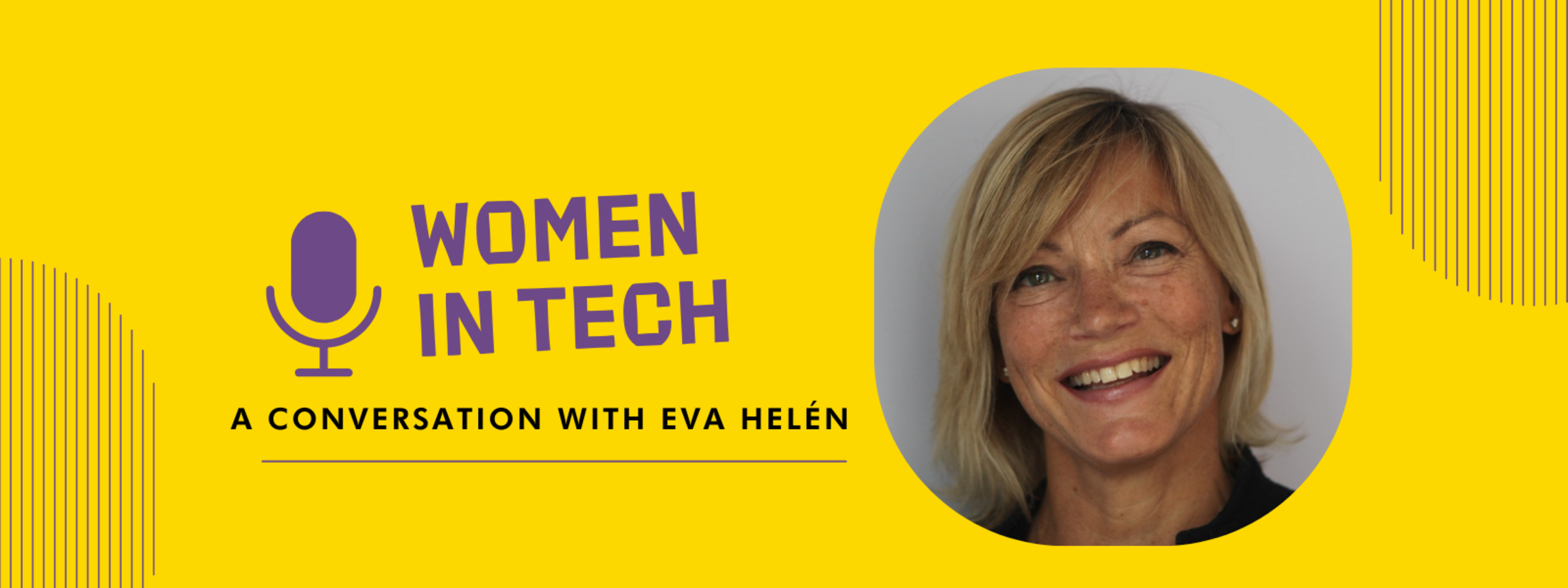
Listen: Tech Founder Eva Helén on Starting Up
With more than two decades in tech, Eva Helén has co-founded, built, and exited two software companies - most recently Sanbolic, acquired by Citrix in 2015. Since 2017, she has influenced a broad range of technology companies to build more diverse workforces and inclusive cultures. Her book Women In Tech: A Book for Guys is based on her research and interviews with men in the tech industry.
We spoke with Eva about her experience co-founding two successful startups and what eventually led her to support the advancement of women and minorities in tech.
Special thanks to Emergent Campus for facilitating this opportunity.
Listen on Apple Podcasts, Spotify, or Google.
Transcript
This is Startup Colorado. A podcast about the rural entrepreneurs changing the state's business landscape from the mountains to the plains and everywhere in between.
I’m Margaret Hedderman. And today we’re doing something a little different. I recently had the opportunity to sit down with Eva Helen, a tech entrepreneur, CEO, and author. We spoke for about an hour, all about her experience co-founding a successful tech startup and how today she’s helping tech companies build more diverse and inclusive cultures. Her book, “Women in Tech – A Book for Guys,” is the culmination of her research and countless interviews with men in the tech industry.
In addition to sharing her story, Eva also had a ton of great advice for startup founders – in tech or otherwise. So, we’re breaking this episode into two parts. In the first section, Eva will share her story and then we’ll hear a condensed version of my interview with her, highlighting some of her insights and advice.
If you enjoy this episode and would like the opportunity to learn more from Eva, I have great news! On March 1st at 10AM Mountain Time, Startup Colorado we’ll be hosting a live ask me anything Q&A with Eva. It’s free, but you do need to RSVP. Head on over the events page at StartupColorado.org to register.
Ok, let’s get going.
Eva: So, I’m going to take you back a little bit further to my first startup.
Margaret: It’s the mid 1990s, and Eva had just moved from her homeland of Sweden to Silicon Valley, where she took a job in international tech sales.
Eva: During that time, I was introduced to one of our distributors… And he was in the process of setting up a software division of that company.
Margaret: They hit it off, and soon, Eva had a fresh job offer on the table.
Eva: I was part of it from the very beginning, so considered a co-founder.
Margaret: The company, Number One GM, was eventually acquired by AutoDesk. After that, Eva and her business partner, Momchil Michailov, started looking for their next project. They had a lot of connections in the telecommunications industry who were all saying they needed help developing software components.
Eva: My co-founder is very technical and said, you know, I would love to continue on this path. I think that there's an opportunity for this type of enterprise software. Why don't we go and do that.
Margaret: To which Eva responded…
Eva: Well, how long is it going to take and he said, God, two, three years, as most founders think and say, it'll take a couple of years…
Margaret: In reality…
Eva: It took a good 15 years, a very long journey with tons of ups and downs before we were actually able to exit.
Margaret: That company was Sanbolic, a shared file storage technology.
Eva: So, this is like the first real, I mean, it wasn't even real cloud. But basically, you could have people for multiple geographically dispersed locations accessing the same data.
Margaret: At the time, this was revolutionary.
Eva: We’re actually showing simultaneous editing of a document from two different servers. I mean, the stuff that we do in Google all day long nowadays, that ability, nobody had ever seen that before.
Margaret: So, Eva and her co-founder are building this company out. Eva handled sales, operations and finance, and Momchil was CEO, product development, and marketing.
Eva: My official title was president and COO. And I really enjoyed having that I didn't have that in the beginning, it was kind of I think it was like VP of Business Development from the beginning, because I didn't want to have a big title. And when we were still a small company. But as we grew out and expand it, and we grew with our roles, I found that that was really great. Very much personally because I had three children during the time that we built Sanbolic.
Margaret: Now, I think I should mention, that Eva’s husband is actually her co-founder, Momchil Michailov. But the entire time they ran Sanbolic together, they kept their relationship private.
In her book, Women In Tech, Eva wrote that venture investors frown upon family-run businesses. It also allowed her to be viewed and treated as a businesswoman in her own right, outside of her marriage. She wrote, (quote) I was respected for my own opinions by our colleagues. My intelligence and decisions were never questioned. (end quote)
I asked her what it was like as a woman in Silicon Valley back in those early years.
Eva: It was great!
Margaret: But, she added…
Eva: I was wearing a pretty thick shield to protect myself, in a scenario in kind of played a role. I was not, I was one person at work and another person at home.
Margaret: She said that, more times than not, she was the only woman in the room.
Eva: A lot of women who who listened to this can also relate to that we all have to prove ourselves you have to prove ourselves over and over so that we are thought of as credible in the message that we're bringing into the room. And I always felt that I have to prove myself I have to show these guys that I actually know what I'm talking about. But all of that said, that wasn't that hard for me. It wasn't painful. It wasn't like in the moment it wasn't emotionally draining.
Margaret: Over the years, Sanbolic weathered many storms, including a failed acquisition by Microsoft after the 2008 financial crisis. But, Sanbolic did eventually sell to Citrix in 2015.
Eva: We had obviously been working so hard for so many years to get to this point, you know, when things look completely hopeless, we would be like, okay, we can do it a little bit longer, we can do it a little bit longer. Maybe at some point, one bigger company will understand how great this technology is, and actually run with it and take it to much bigger places than we could ever bring it ourselves. And like I said, even though I did have these protective mechanisms in place to to defend myself or protect myself, during the years that I was running Sanbolic, it was my show, and I was very comfortable, and I also had a great team of men around me at work, who were always supporting me and what I was doing. So, I never felt threatened or, you know, less important or less valued or anything like that, I was always 100% at my capacity, and it was fantastic. So, when we started talking to Citrix, and I remember very clearly having a discussion with the then CEO. And I said, Well, you know, read through the documentation, both that of my, my own documentation and that offer of my coder. And I'd like to get a VP level, and $1 for $1 of what he's going to be making and a corner office just the same as he. And this man told me, well, you're going to have to prove yourself. And I thought, whoa, wait a minute, that was like a punch. That was really uncomfortable. What do you mean, prove myself, haven't I've been building this company side by side with my co-founder for 15 years? Isn't 50% of what we’re presenting to you something that I have done. And I was very confused, and very, very upset, and I got very angry. And maybe it was because I hadn't been exposed to situations like that, where it was, like, my whole being and everything that I'd done for so many years, I felt like it was being questioned.
Margaret: Eva and her co-founder talked it through together and with their investors. They went back and forth, trying to decide the best course of action. Eventually, Eva said…
Eva: It really was my fiduciary responsibility to find the best opportunity and the best deal for our investors. And so, for me to be selfish in that moment, that sort of thinking about my own pride, I kind of had to swallow it and just say, all right, I'm sure that this will work itself out, I'm sure I will just, you know, start working there and I can figure it out from there. But I, I was really unhappy. And for a long period of time, most very, very angry. It didn’t become any easier as we started working there. They were not in favor of me succeeding and the ever evasive promotion to VP seemed completely impossible. I continue to make five cents to a dollar of what my previous co-founder was making and, so when after year we had an opportunity to leave we were like thank you very much we're out of here. On to the next.
Margaret: Today, Eva is the founder and CEO of EQ Inspiration, through which she helps companies build more diverse workforces and inclusive cultures.
As I mentioned, I spoke with Eva for about an hour. And there were just so many great pieces of advice that came up in our conversation, so I wanted to present them as a straight up interview.
And, just a quick reminder before we begin, we’ll be hosting a free Q&A with Eva on March 1st in which you can ask her anything about founding a startup, building a better DEI culture at your business, or anything else. Signup at Startup Colorado.org.
Q&A
Margaret: So, was the experience you had with Citrix what inspired you to pursue your work now within DEI?
Eva: You know, it was there definitely a triggering… sort of triggering year, it made me think a lot. But I also don't believe in being bitter or negative. I'm a very positive and, and sort of opportunity and optimistic driven person. So, I really wanted to turn this into something constructive, something good, something that I could help other women not have to go through. And if we just revamp, we rewind, like 25 years, when I was still in Sweden, and I was University, I was up on the barricades fighting for women's rights. And I thought that I would be really working in HR or working in organizational behavior, and really speak to equality at tech between genders primarily. So, here I am finding myself back in Silicon Valley, and trying to figure out what was I going to do next. I ended up going to tons and tons of networking events for women. And the conversation was very similar to the one that had been around 20-25 years ago, where people, women were still very unhappy about a lot of different things. And I thought, well, this is just not constructive. And I've worked in tech for 20 years at this point, and there's so many great guys, amazing supportive men. Where are they? Why aren't they here? So, that's when I started women in tech events for guys as a way for men to be comfortable coming to a place where we could discuss these things, across genders, and across power structures, across business roles and generations, finding people who wanted to chat about this and figure out how can we actually make things better, without any stress of feeling, you know, exposed or vulnerable. And that eventually led me too, you know, doing my research and writing my book.
Margaret: And you had you had mentioned earlier about how having different perspectives and having a more diverse staff within your company actually is is good business. Can you expand on that a little bit?
Eva: I typically think about, you know, three things, innovation, productivity and retention. So when you're, when you're building a company, and you're starting to have just everybody with the same background as you, you will get to a certain point where you're like, okay, we can't really come up with any more ideas like what's going on, we're getting stuck here. Maybe it's on the product side, maybe it's like how you bring the product to market, maybe your, it just feels like you're hitting your head in the wall a few times. And so bringing in people that have different backgrounds, and different experiences than you have, will actually help you. You might have more conflict in your discard, you might have more problems coming to the conclusions, you might have to experiment a lot more, but the creativity that's released, by pushing each other, questioning each other, challenging each other is really important for the whole, everything around innovation, but not just innovation, everything like the whole business, how you want to run it, you want to scale it, and so on. So, you know, throughout the the career of the company itself, you will have different constellations of people. And you will find that the company itself almost outgrow some of the people that are hired early on. So, you need to add more other people to the mix. Because that will also bring out new good things in the people who you already have on staff. Retention is really a lot around how people feel, okay, so a lot of people companies are shutting shutting staff like crazy, which might be great for you if you're a startup because they'll come and look at you instead. However, when you're at that, that company who's now maybe at 50 employees, and you're all excited and things are going great, and then all of a sudden people start leaving, then you really need to think about why are they paying. And doing surveys, we don't like surveys necessarily, but it's really important to do companywide surveys and understanding how people are feeling when they're at work. Are they feeling valued? Are they feeling seen, heard or respected? I think a lot of this stuff is accessible in the book just by reading also what some male leaders are already doing just for their team level or their organizational level. But it's a question of things like improving communication. It's a question of elevating the coworkers that you have, so that they, you don't necessarily need to celebrate everything that they're doing well, but really need to make sure that they're getting good feedback when they deserve it. Because we all like good feedback. And it makes us feel like it's worth getting up the next day and going to work for somebody else. The retention pieces, I mean, I could talk about that for a long time. But let's leave that one to the side for a little bit and talk about productivity. Because they kind of go hand in hand, we know that productivity goes up, improves, when people thrive. When people are in a good place, they feel good about what they're doing, they end up being more productive. So, if you have that diversity in the team where people feel included and they are productive and they can thrive, then the outcome of the business will obviously be way better than if people are miserable. It kind of not very difficult to understand, but it's a little tricky to do it and make sure it happens.
Margaret: Do you have any advice for tech startups that are just getting going to implement a strong DEI policy and culture from the get go?
Eva: Now, like I said, for the beginning, that's not like the first thing that we think about right? When we've just started up, and we're just building our team, and we just want the best talent. That's the most important that we know that maybe we can hire this person if we can afford him or her, and so the thinking is very different. However, it's not too early to start thinking about this. And I find that companies that reach, you know, maybe they've taken seed round, maybe they've even taken an A round. And once you graduate, then you start to grow out of the funder, founder and engineering stage. So, in the beginning, all companies kind of look the same, you don't really care about if people are of different colors, or what preferences they have, or if they're men or women, you just hire the best people you can find for what you can afford. But once you start graduating and growing out of that founder and engineering team setup, you start to hire salespeople, you hire, start to hire operations people, maybe even somebody on the HR side, that is the time to start thinking about what do we want our company to be like? What kind of culture do we want at our company? What do we want to project as we're going out and hiring people? What do we want our potential customer partners see when they look at us? So obviously, your website is going to be really that face outward. What does that look like? If you don't seem to be able to attract women in sales, for example, for your sales team? Call on a bunch of women who you know, and ask them would you see when you come to our website would you read and how come you wouldn't apply for this job if you've put out a job ad. It's really not too early to start thinking about it very conscientiously already from the very beginning. Because if you take funding, you will start to grow very, very quickly. And revisiting this topic frequently is is good to do. But it's also really good to like as a leadership team, as the co-founders sort of say, we should probably pay a little bit of attention to this. Because the competition out there is brutal, right? You want the best talent, and you're not going to attract the best talent, if you don't have that face outward of what it is that you would like other people to see, so that they come to your jobs.
Margaret: Well fantastic, that is all I had for you. Is the anything that you had wanted to talk about that we didn’t get to?
Eva: I think I just want to like a couple of words of encouragement. Being a startup founder or CEO is difficult, it's hard to be very lonely, it's a journey that you don't know when it's going to end, it doesn't have just a start and finish date that can kind of go on forever. You'll have days when you're miserable, because things are really, really difficult. And things that, and days that things feel like, okay, everything's looking up, we're actually going to succeed, this is going to go our way or this company is finally going to invest in us. Throughout those ups and downs, just somebody who's done it multiple times, and for many, many years, keep yourself level headed as much as possible. Take good care of yourself and your health, and the people around you who you love because when it's all said and done, that's what you will have left. Your company may succeed, it may not succeed, but at the end of the day, you will always had what you started with, you know, the people around you, who you love and that love you. And, and your health is really, really important. So that's really what I want to say just take good care of yourself as you're on this journey. And reach out if there's anything I can do to help.
Margaret: This episode was facilitated by emerging campus in Fremont County. Learn more about their work at emergingcampus.com
The Startup Colorado podcast is produced and edited by me, Margaret Hedderman. Our theme music was written and produced by Erin Roberts of Perlolo Music. Additional research and support was provided by our podcast research assistant, Elise Ertl. The Startup Colorado podcast is made possible by gracious supporters like you. Learn more about becoming a sponsor or making a personal contribution of any amount by emailing [email protected]